The great promise of AI is increased productivity and accomplishing bigger, better things. The great risk is that productivity comes at the expense of critical thinking and long-term growth.
You might feel this in your work. How sharp is your syntax? How often are you having novel ideas? We're producing more, but it's not clear that we're getting better.
The solution is not to reject AI. It's to use AI in ways that develop our capabilities and measure progress by something other than our outputs.
To do that, we need to understand different barriers to progress.
Sometimes, we're on a plateau and need to keep going. Others, we've reached a local maximum and need to change direction. In reinforcement learning, this resembles the trade-off between exploitation and exploration.
Plateaus
A plateau is a period of little progress. Mathematically, it resembles a region where the slope is near-zero: continued movement produces little change.
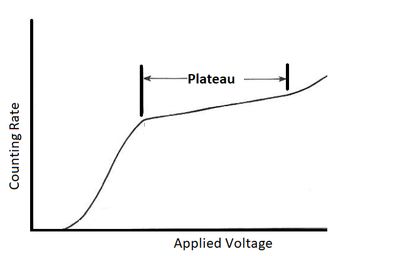
The dreaded plateau, visualized
The underlying direction is still correct and effort eventually breaks the plateau.
In the above image, increasing voltage eventually results in a steeper curve. If the underlying strategy is sound, we escape plateaus by continuing to exploit existing strategies (increase voltage).

However, not all stalls are plateaus - we can't always brute force our way out of problems.
Local maxima
Local maxima are suboptimal points that may appear to be optimal. You might find yourself in a local maximum if you've ever tried to do a hard thing: You're better off than when you started, but progress eventually halts.
In typing, hunt-and-peck is a local maximum. It is faster initially than switching to touch typing, but it imposes a substantially lower ceiling. You're in a local maximum that requires intervention to continue progress. Exploiting hunt-and-peck is a losing game.
Mathematically, a local maximum refers to a solution or state that is better than its immediate neighbors, but not globally optimal. An algorithm that finds a local maximum might say, "Yeah, this is good enough," and not properly seek out alternatives.
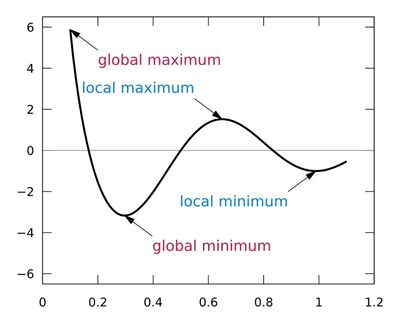
Local and global maxima and minima
To escape the local maximum, we have to explore alternative strategies for continued progress.
The promise
The promise of AI has been increased productivity and capability. The problem is that these come at the expense of personal growth.
We are getting more done, but at a local maximum.
Without challenging how we use AI we are defining success by what a next-token predictor can produce instead of our own capabilities.
Instead, we should be tying success to our ability to think critically, be creative, and use tools (like AI).
Experienced workers use AI well because they spent years solving problems without it. But those are the same formative experiences that AI now replaces - one reason new grads are uncertain about the job market.
Reliance on AI weakens the same systems that make us capable.
This comes from a bias towards outputs over understanding. But further exploiting AI solutions will not improve our understanding. Instead, we must bias understanding over outputs.
But what does that mean? It means we have to explore alternate solutions.
Towards a global max
Some strength movements require substantial ranges of motion. Limited mobility prevents us from performing those movements effectively and constrains long-term progress.
I'm sure someone will tell me deep squats are bad - 1) they're wrong and 2) I can squat more than them.
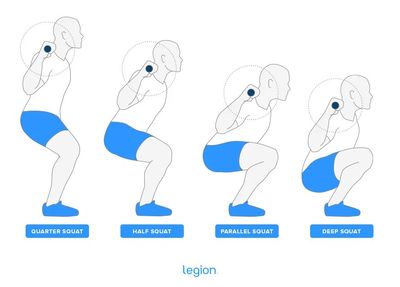
A deep squat requires ankle dorsiflexion, thoracic mobility, and hip mobility. To get good mobility, you need to spend time in positions that challenge your range of motion - limited range of motion creates its own local maximum.
A quarter squat lets you keep training, adding weight, and feeling like you're progressing, but it avoids the positions that would truly expand your capacity.
The deeper squat may be worse at first: less weight, more discomfort, slower progress. But that temporary regression is what moves you toward a higher peak.
What's required is an intervention:
- Add dedicated time to improving your mobility through stretching.
- Add strength movements that improve your mobility.
Option 2 is desirable for several reasons, the biggest is that it's a positive feedback loop.
Good training → better mobility → better training. Once we have good mobility, better mobility becomes easier.
In order to use AI well, we must understand systems.
If we find work that improves our ability to reason and gets us the benefits of AI, we will avoid local maxima and continue to progress.
That may be accomplished through an intervention:
- Dedicate time to improving our critical thinking
- Adopt workflows that improve our critical thinking
Both are excellent, but few are asking "how do I add more things to do each day?" That's why I advocate for option 2.
Just like exercise selection, we can improve our abilities by thinking critically about our workflows and how we approach our daily practice.
It's not surprising that AI has put us in a local maximum - it's a new technology.
Before the automobile, humans used manual modes of transportation out of necessity - it wasn't hard to get steps in when everyone walked to work. Today, walking and cycling are largely recreational modalities.
We used to exercise out of necessity; now we exercise for our health. We used to reason out of necessity; now we must reason out of habit.
To benefit from AI, we have to actively seek out workflows that challenge the skills we want to improve. Knowledge work is no longer self-improving - we have to make it so.
A special thank you to the following articles:
- Local minima, saddle points, and plateaus by @anorangeduck
- Local minima by Mike Fisher